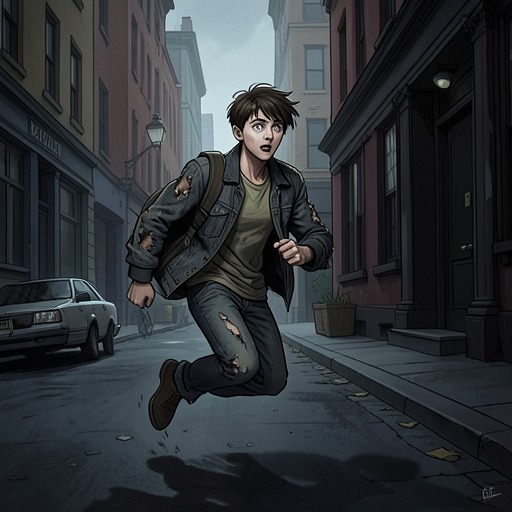
Gino Attacks His Father and Flees Home
Sonne und BetonGino’s attack on his father and flight from home turn an unseen history of domestic violence into an immediate crisis for his friends. The group first hears of the assault through a panicked telephone call from Gino’s mother; only afterward does Julius disclose that he had urged Gino to act and supplied him with Tilidin. His account makes the violence both an emergency and the consequence of a desperate, dangerous plan.
The Home Situation Behind the Attack
The news reaches Julius while Lukas and Sanchez are with him. A woman is crying on the phone, saying that Gino has run away, that everything is covered in blood, and that Henry Ebert is on the floor; she does not know whether he is still alive. Lukas recognizes her as Gino’s mother. She says she has already called the police and an ambulance, and asks the friends to tell her immediately if Gino appears or gets in touch.
Julius is initially unable to respond. When he finally explains, he says Gino struck his father on the head with a glass bottle and kicked him while he was down. The glass also cut Gino’s entire hand, and his whereabouts are unknown. Lukas and Sanchez find the account hard to reconcile with the Gino they know: Lukas insists that Gino would never do such a thing, while Julius confirms that it happened. The report thus overturns their image of the gentle, peaceful friend without yet telling them whether either man will survive.
Julius then admits that he told Gino to attack his father and obtained Tilidin for him. He describes Henry Ebert as someone who drinks and beats Gino and his mother in front of him. Gino had told Julius that he wanted to escape with his mother and brother, but could not make himself leave and believed Henry would keep them from going. From his room, Gino heard Henry shouting and his mother screaming, while feeling powerless to intervene. The assault, as Julius explains it, was intended to make Henry unconscious long enough for the family to get away; Gino had hesitated, and Julius expected Tilidin to remove those inhibitions.
Julius’s Rationale and the Limits of Intervention
Julius’s explanation is not only about the assault but about the choices that preceded it. He says Gino had told him Henry Ebert stole the 200 euros Gino received from selling the computers. Julius presents the money as another sign of the father’s abuse, adding it to the drinking and violence at home. When Lukas challenges his decision to supply Tilidin instead of contacting the police, Julius erupts, asking what the police could do. His answer exposes the gulf between Lukas’s appeal to outside authority and Julius’s conviction that Gino’s family was trapped beyond its reach.
The exchange becomes physical in its details even though it takes place among the friends: Julius spits on the floor, shouts, and takes a deep swallow of vodka as the train slows. Other passengers turn to look. His distress does not undo his responsibility; he acknowledges that he urged Gino to use the bottle and arranged the drug, while insisting that he acted because Gino was his best friend. Loyalty has become a form of intervention, but one that helped make a violent plan possible.
Julius recounts that Gino wanted to flee with his mother and brother, yet felt unable to act while Henry kept the family confined. Gino had described hearing his father roar and his mother scream from his room, unable to help her; he felt like a failure because he could not protect her. Julius’s proposed solution was to incapacitate Henry temporarily so the others could escape. Gino initially resisted, and Julius believed Tilidin would suppress the hesitation. But the reported outcome is more severe than the plan as Julius describes it: Henry is found on the floor, Gino has a badly cut hand, and the family’s whereabouts are uncertain.
Flight, Waiting, and the Hospital Update
Julius insists that Gino’s SIM card stay in his phone in case Gino’s mother calls again. Then he notices that they must get off at Neukölln, and he springs up; Lukas and Sanchez follow, jumping out just as the train doors close. The station is nearly deserted. Between the S-Bahn and U-Bahn levels, they pass people sleeping on the floor and a man inhaling lacquer from a plastic bag. At the platform, with the next train toward Rudow due in five minutes, the three sit together without speaking. Sanchez offers cigarettes. Lukas smokes and watches rings drift through the smoke, while his thoughts return to a friendship that began in childhood and a plan to move in together at eighteen, leaving Gropiusstadt for the busier city. He hopes Gino is alive and will not face serious trouble, holding onto the contrast between the attack and the friend he knows as gentle and peaceful.
A later call brings news, but not certainty. Someone has found Gino unconscious at a bus stop on Fritz-Erler-Allee and called an ambulance; Gino is now at Klinikum Neukölln, and his mother is on her way there. Julius does not know whether Gino is alive, though he thinks the hospital would have told his mother if he had died. The assault’s immediate aftermath therefore ends in suspension rather than resolution: Gino has been located and taken to hospital, but his condition remains unknown to his friends.
Narrative Significance
The episode is structured as a chain of belated recognition: a distressed call first makes the friends confront the possibility of death, and Julius’s account then reveals that he helped set the assault in motion. That reversal does not make Gino’s violence simple or justified. Instead, the gap between Julius’s intention—to create a chance for the family to escape—and the bloody, uncertain result exposes how care can become dangerous when friends act in place of help they do not trust to arrive. Lukas’s disbelief and his memory of Gino as peaceful keep the event from settling into a single judgment; his hope that Gino survives exists alongside the knowledge that Gino has seriously harmed his father. With Gino found unconscious but his condition still unknown, the crisis leaves friendship, responsibility, and fear unresolved.